Behind the Framework
Reduce Complexities & Improve Performance
Leveraging what's already in your browser
The Evolution of Web Architecture
Over the past two decades, web-based architectures have undergone a significant evolution. A primary driver of this shift is the substantial expansion of browser capabilities across HTML, CSS, and JavaScript, which has led to a proportional increase in client-side responsibilities. To manage this growing complexity, the engineering community developed and adopted a vast ecosystem of frameworks and libraries designed to solve legacy browser limitations.
The Hidden Cost of Abstraction
As reliance on these libraries grows, engineers operate increasingly within abstraction layers rather than with native web standards. This separation causes skill atrophy, where deep knowledge of specific libraries replaces a fundamental understanding of the platform. Consequently, teams become dependent on these abstractions to bridge their knowledge gaps, often retaining legacy libraries for convenience while overlooking superior, modern web capabilities.
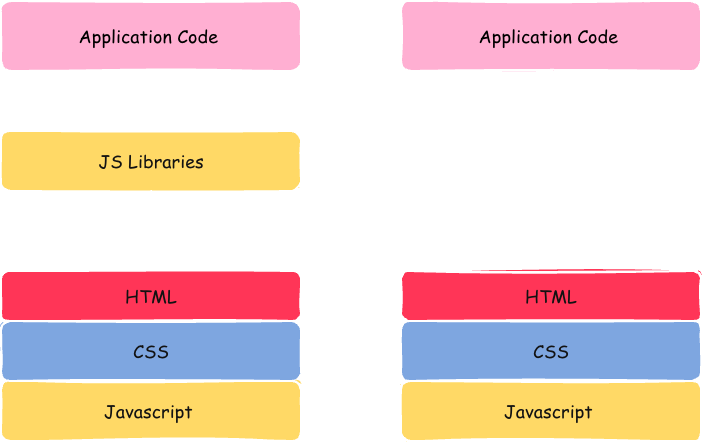
While frameworks offer utility, their widespread adoption often results in over-engineered solutions that suffer from performance overhead and high maintenance costs. Many modern libraries are now redundant, as they merely replicate functionality that is effectively handled by the lightweight, native capabilities of the modern browser.
Our Mission
The purpose of this site is to showcase lightweight solutions built on these modern standards. We highlight lesser-known and emerging capabilities in HTML, CSS, and JavaScript to provide low-complexity alternatives to heavy library adoption.
We encourage engineers to adopt these native patterns and eliminate reliance on third-party libraries. This strategy significantly reduces code complexity and boosts performance, while ensuring accessible user experiences are aligned with modern industry standards.
Benefits adopting native UI solutions over JavaScript libraries
- Maintainability - Simply put, low complexity solutions are easier to maintain
- Time-to-market- With lowered complexity is your architecture, engineers can respond to updates & enhancements faster
- Application Performance - Native solutions leverage APIs the browser gives us for free. This reduces payloads shipped to the browser & overall hydration at the client. This pattern leads performance outcomes no framework can compete with.
- Futureproof - Native solutions have a longer shelf-life over frameworks.
- Documentation, Knowledge - Native solutions are well documented specifications that are easily accessed
- Dependency free - All native solutions are dependency free which reduces risks to platform stability and regression.
Leveraging modern HTML JS & CSS, architects can appreciate these benefits & avoid adopting verbose libraries in their solutions. By showcasing interactive samples and discussing modern architectural patterns, this site aims to help architects throttle complexities, optimize the performance of your solutions and reduce dependancies.
Note: While this site advocates to avoid using frameworks, we are not recommending never to use them. Frameworks have practical use-cases and should be leveraged when application complexities call for it. Engineers should always strive for the right balance between application (UI) complexity and architectural complexities. In other words, simple problems should have simple solutions. Adopt frameworks only when its complexity can be weighted evenly against the problem you are solving.